
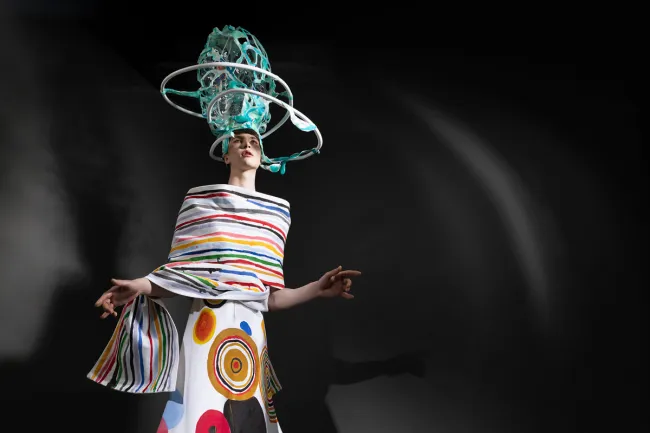
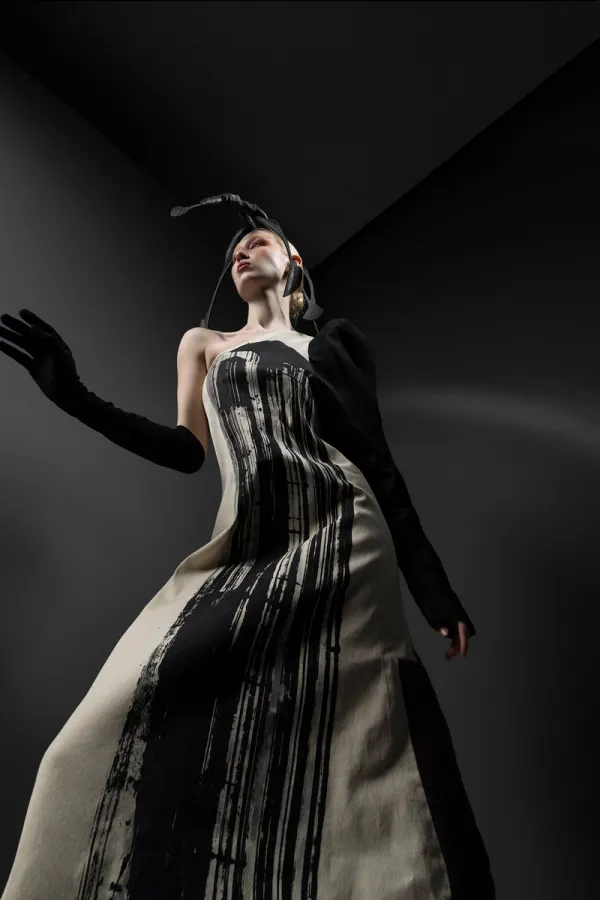
The Lázaro Galdiano Museum in Spain is hosting a unique celebration marking 20 years of innovation, commitment, and cutting-edge design for an ambitious project that has traveled the world and is now arriving in Madrid for the first time. Until April 12, the museum is hosting the exhibition Fashion Art by Manuel Fernández, featuring 25 garments created by the Spanish designer and embellished by some of the most renowned visual artists on the national and international scene: Abraham Lacalle, Agustín Ibarrola, Anzo, Carlos Gorriarena, Ceesepe, Eduardo Úrculo, El Hortelano, Equipo Límite, Jarr, José Manuel Ciria, José San León, Juan Genovés, Luis Gordillo, Manolo Valdés, Matías Sánchez, Miquel Navarro, Olga Andrino, Ouka Lele, Pedro Paricio, Rafael Canogar, Suso 33, Olga Sinclair (Panama), Grimanesa Amorós (Peru), Charles Villeneuve (France), and Teruhiro Ando (Japan).
The exhibition brings together a carefully curated selection of the 300 garments that make up the collection, interpreted by artists of 46 nationalities—using techniques ranging from the cutting edge of Street Art—becoming a celebration of creativity and artistic expression. Each dress, which invites different interpretations, is a work of art that reflects the artist's vision and language. At the Lázaro Galdiano Museum, it not only establishes a dialogue with classical works but also connects with the dissemination of contemporary art that the Madrid institution promotes. In this unique exhibition, “Fashion Art” also draws attention to some of the 17 Sustainable Development Goals and the values of the European Union, through garments that reference environmental protection, respect for human dignity, freedom, equality, identity, human rights, diversity, and more.
Art in motion through garments that transform into canvases and, on the skin, express different perspectives, ways of understanding, and emotions.
“Fashion Art is a concept where fashion and art merge; it’s the search for a meeting point between both worlds in a natural way, without excessive embellishment,” explains Manuel Fernández, who began his career at the Gaudí Fashion Show and was the first Spanish designer to show his collection at New York Fashion Week between 2000 and 2004.
More than an exhibition: a visual manifesto on cultural integration and social commitment.
Manuel Fernández and the Fashion Art Institute have demonstrated a clear commitment to service since 2007, when in Colombia, together with the First Lady, Lina Uribe, they launched a training seminar for the widows of soldiers in garment workshops seized from drug traffickers. Thus began a story of social action that continues to bear significant fruit today: training and empowerment workshops, product line design to raise funds, auctions, fashion films, and more.
In Panama, he has worked with preschools for underprivileged children; In Guatemala, artisanal textile workshops combined with local visual artists; in Ecuador, a project for young artists in Guayaquil; in Puerto Rico, a creative work with more than 20 schools and a workshop for single mothers of Fashion Food and incarcerated women.
In Spain, he regularly collaborates with APRAMP and various NGOs, where his designs are brought to life and where he leads training and skills development workshops, as well as awareness campaigns and fashion shows featuring designs created by victims of trafficking, young people with intellectual disabilities, and, in general, people at risk of social exclusion, who learn and participate in an artistic project as a means of social integration and personal development. “I have seen the transformative power of art and fashion in life, in the creation of community,” the designer admits.