
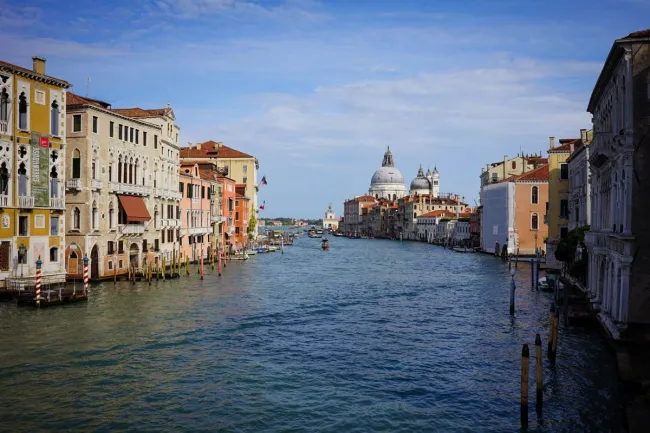
On 4 November 1966 the sea rose almost two metres into Venice. The world's response changed how we think about saving old cities. Now the paperwork of that rescue, 110,000 documents of it, is going online.
I have been flooded exactly once, by a washing machine, and I still talk about it. Venice has been flooded on more days than anyone has bothered to count. But there is one flood that Venetians refer to with a definite article and a dialect name, as if there had only ever been one: the Aqua Granda, the big water, of 4 November 1966.
That morning the tide, driven by rain-swollen rivers and a sirocco wind that would not let the lagoon drain, reached 194 centimetres above mean sea level. It is still the record. Water stood a metre and a half deep inside St Mark's. The same day, 250 kilometres away, the Arno burst into Florence and drowned the Uffizi's basement. Italy's two most photographed cities went under together.
The good news, sixty years on, is that the story of what happened next has been kept, in extraordinary detail, and is about to be opened to anyone who wants to read it.
The flood that invented a movement
Before 1966, the idea that the whole world might take responsibility for one city was not obvious. After 1966 it became normal. Within months, private committees had formed in a dozen countries to raise money for Venice: Save Venice in the United States, the Venice in Peril Fund in Britain, and others in France, Germany, the Netherlands and beyond. Most of them are still at work.
UNESCO took the lead. It launched an international campaign for Venice, and in 1973 it opened an office in the city, which grew into its Regional Bureau for Science and Culture in Europe. The campaign is credited with pushing the Italian state into its first Special Law for Venice, the legal framework that has governed the city's protection ever since.
What the committees and UNESCO paid for was not glamorous. It was drains, foundations, roof timbers, stone consolidation and the slow cleaning of frescoes, hundreds of projects over half a century. The paper trail of all that work is what the new project is about.
What is in the archive
The UNESCO office in Venice holds the institutional archive of the campaign from 1966 to 2015: around 110,000 documents, a photographic collection of some 6,000 images taken between 1970 and 2017, and audiovisual material in formats that are themselves now historic.
On 3 November 2026, the eve of the anniversary, UNESCO and the Fondazione Giorgio Cini announced a two-year project to digitise it. The work will be done at the Foundation's Digital Centre on the island of San Giorgio Maggiore, across the water from St Mark's, and the material will be released in stages to scholars and the public.
The project covers two chapters. The first is the archive of the International Campaign for Venice itself, from 1966 to 1992. The second is the joint programme that UNESCO ran with the private committees from 1992 to 2015, the period in which the rescue became routine.
Magdalena Landry, who directs the UNESCO bureau in Venice, makes the point that the archive is about people as well as projects: it records who made which decision, what they knew, and which institutions had to agree before a single stone was touched. Gianfelice Rocca, the Foundation's president, calls archives living entities and tools for understanding the present rather than monuments to the past.
A restoration leaves you with a building; the file leaves you with the argument: who thought it was worth it, who disagreed, and what it cost. Fifty years on, the argument is often more useful than the building.
Why it matters now
Venice has not stopped flooding. The second-highest tide on record, 187 centimetres, came on 12 November 2019, and it took until October 2020 for the MOSE mobile barrier, under construction since 2003, to be raised against the sea for the first time. The barrier works, but it is closed more often every year, and each closure is a trade-off between the city and the lagoon that feeds it.
The lesson of 1966 is not that Venice was saved. It is that saving it turned out to be a permanent job, done by a shifting coalition of governments, foundations, engineers and private donors, most of whom never met. The archive is the record of how that coalition learned to work. Other cities facing the sea, and there are many, will want to read it.
There is a practical side too. The project funds scholarships to train young people in archive digitisation, and it plans to reuse the material in new artistic and narrative work, so the photographs and films of the rescue do not simply sit on a server.
If you are going to Venice
- San Giorgio Maggiore: the Cini Foundation's island is a two-minute vaporetto hop from St Mark's. The Palladio church is free; the bell tower has the best view of the city, with none of the queue at the campanile opposite.
- The high-water marks: look for small plaques at knee height in the streets around St Mark's marking the 1966 level. They are higher than you expect.
- Acqua alta season: October to January. Raised walkways go out when the forecast passes 100 centimetres; above 140 the sirens sound. The city's tide forecast is published daily and worth checking the night before.
For another story about how we remember our relationship with nature, see our piece on Arcadia at the Natural History Museum.
Sixty years of paperwork, worth reading
I went into this expecting a dry story about scanning. It is not. It is the story of the moment a city stopped being Italy's problem and became everyone's, written down by the people who did the work. In two years you will be able to read it from your sofa.
The water will rise again. The difference is that this time, we will know exactly how we answered it last time.
This article is for general information and reflects the project as announced by UNESCO and the Fondazione Giorgio Cini on 3 November 2026. Remarks by Magdalena Landry and Gianfelice Rocca are paraphrased from UNESCO's announcement.