
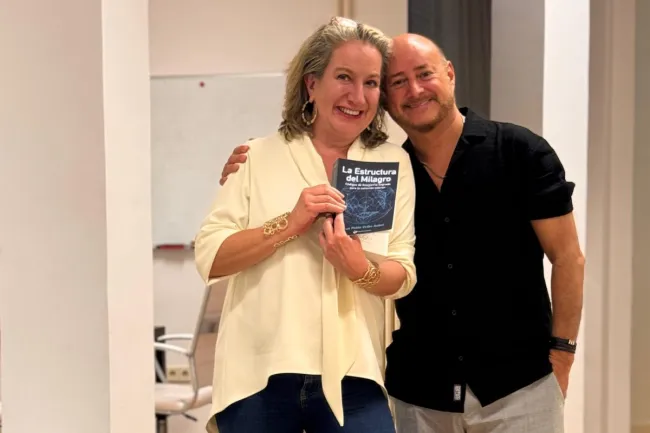
And who is he? A Chilean therapist, teacher, and author born in Santiago in 1968, who has spent years exploring healing from an unconventional perspective: one that unites art, science, and spirituality without losing depth or rigor.
Juan Pablo has not only created his own method, Bioaxis®, based on sacred geometry, archetypes, and practical spirituality, but he has also integrated knowledge as diverse as bioenergetics, synergetics, and quantum physics. The result? A comprehensive view of the human being as a living and symbolic system in constant evolution.
This year, 2025, a year he considers key for the evolution of planetary consciousness, he has crossed continents to present his book The Structure of the Miracle and share his workshop Toroidal Science. The goal? To invite each person to reconnect with their life purpose through a lucid and conscious spirituality. No magic recipes or self-help formulas. Juan Pablo invites you to take charge, look within, and accept that healing—true healing—begins with a radical decision: your own.
I couldn't pass up the opportunity to talk with him, and here I share our words, which were more than an interview, a brief journey toward the essential.
Spoiler alert: I ended up with a slightly clearer heart... and eager to dig deeper.
Do miracles have structure? Isn't that a contradiction between the inexplicable and the structured?
What I propose in the book is that what we call a "miracle" is not something supernatural or something that fell from the sky without explanation. On the contrary: miracles have structure, a logic, a design. What happens is that we are not used to perceiving that structure because it manifests itself on very subtle levels of reality: the energetic, emotional, and mental world. We live in a profoundly materialistic culture, where what is not measured does not exist. But we all feel, we all intuit. That inner world—what I call the "subtle world"—has an order, and that order is what I explore in this book. Magic is simply a science that we have not yet understood. And when you understand it, when you can name it, you stop seeing it as an unattainable mystery and begin to experience it as part of your everyday life. That's the book's great message: the miracle isn't something that happens out there, but inside us, and it has a structure that we can study, understand, and apply to transform our lives.
What we call a miracle is not an inexplicable mystery, but a subtle structure that can be known and applied.
You speak of “a shift in perspective in our consciousness” as a fundamental key. What does this imply in practice?
Changing your perspective isn't simply about "seeing things positively." It's something much deeper. It has to do with where you're looking at life from. Our experience is filtered by beliefs, unresolved emotions, family histories, traumas. What we usually call "reality" is, in many cases, a projection of that internal world. So, if you manage to modify that internal point of view, everything changes. In the book, I talk a lot about sacred geometry as a tool to understand that change. For example, the Toroid, a three-dimensional figure that represents how energy flows in the universe. We function the same way. If the center is contaminated, everything we project will be as well. But if we focus, if we look from a more lucid and conscious place, even the most painful things can be redefined. That's why I say that often the existential void isn't real, but a matter of angle: from where you're looking. You change your perspective, the world changes. And that's not poetry: it's neurobiology, it's quantum physics, it's applied consciousness.
What we usually call 'reality' is, in many cases, a projection of that internal world.
You affirm that healing depends 100% on each person's decisions and that 2025 will be a key year for the evolution of planetary consciousness. How are these two aspects related?
Healing isn't something that comes from outside, nor a gift someone else can give you. It's a radical choice, an act of inner sovereignty. Every time you decide to look inward, take responsibility for your story, question your beliefs, forgive, let go, or act from coherence, you are healing. No technique will work if you don't make that profound decision. And 2025 is a key year because we are at a kind of crossroads: ecological, social, technological crises... Everything is accelerating. But this isn't about alarmism, but about opportunity. When the system collapses, consciousness can expand. External structures no longer support us as they once did, and that forces us to turn inward. At the same time, technology is amplifying everything: from misinformation to guided meditation. So the great challenge of this moment is to use this context not to run away from ourselves, but to awaken. I think the world is in its adolescence: confused, impulsive, but also full of potential. This year can be a turning point, but only if everyone plays their part. Global transformation begins with an intimate, deeply individual decision.
Loving and being loved is common in all cultures.
How does this vision integrate with other more traditional therapies or disciplines?
Perfectly. I'm not here to replace anything. What I teach can be integrated with any therapeutic, psychological, or medical path. In fact, it enhances it. Because what I offer is a framework, an archetype: the underlying structure in which all human experiences are inscribed. It's like having a map of the forest before entering: it doesn't tell you how to walk, but it does guide you. This vision helps contextualize what you're doing, to understand why something works or doesn't. And it's also a spirituality adapted to today's pace: we don't need to go to Tibet or meditate three hours a day. We live in noisy cities, with families, jobs, and responsibilities. So the proposal is a realistic, functional spirituality, without losing depth. Self-healing techniques, simple but effective exercises, intimate emotional work. You don't need to relive your traumas, but rather understand the root and reprogram from there. And this is compatible with psychology, with coaching, with medicine. The key is understanding that the human being is an integral system: mind, body, emotions, and consciousness.
True transformation begins when we accept that healing is a personal decision, not just an external solution.
Do you think there are essentially evil people in this world?
It's not about justifying the unjustifiable, but rather understanding what lies behind it. What we often call evil is unresolved pain, a deep disconnection. A person who harms, who wounds, generally hasn't realized that by doing so, they also hurt themselves. And that's not a naive idea or a pretty theory: it's something clearly observed when you study how the unconscious operates. Aggression, manipulation, cruelty—these are often clumsy attempts to protect something internal that feels threatened or broken. Does that mean it's okay? No. But it means there's a way out: reconnecting with one's own essence. I don't believe in inherently evil human beings. I believe in people disconnected from their luminous nature. When you understand that, you stop reacting with judgment and begin to act responsibly. Sacred geometry, for example, shows us that everything in life has a natural pattern of harmony. When we break that pattern, we suffer. And by restoring it, we heal. That's why inner work isn't a luxury or self-help: it's an urgent way to regenerate the human and collective fabric.
What we call evil is a desperate cry for love.
How does it feel to inhabit a planet as strange as that of humankind?
Sometimes it feels like living inside a labyrinth: contradictory, chaotic, emotionally overwhelming. But it's also wonderful. Being human is an intense experience, full of layers, lights, and shadows. The strangeness isn't outside, it's inside us: our emotions, thoughts, wounds. And yet, that chaos is fertile. We came to remember who we are, to reconcile ourselves with all of that. Inhabiting this body, this being, is the deepest spiritual adventure there is.
There are questions that unsettle us in order to place us.
I'm eager to read The Structure of the Miracle. Not only because I'm drawn to healing and spirituality (which I am too), but because I sense, as I mentioned at the beginning, that it can help me put together some of the pieces I've been mulling over. Sometimes we just need someone to say out loud what we've been feeling in silence. And Juan Pablo does it without any fuss, without dogma, but with a depth that shakes you.
The most powerful thing about this encounter, I think, has been realizing that I don't have to stop being myself to transform myself. I just need to adjust my perspective. Thank you, Juan Pablo, for reminding me that the miracle begins within... and that daring to truly look at oneself is also part of the magic. I'm ready!!