
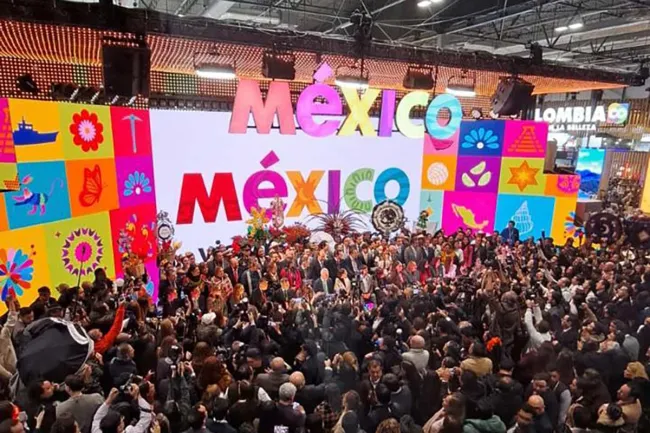
During Mexico’s participation as Guest Country at the International Tourism Trade Fair (FITUR) 2026, connectivity with Europe and investment attraction were strengthened through announcements of new air routes, flight expansions, and agreements with hotel and financial groups to boost tourism projects in the country. These new routes include those from Aeroméxico, which will connect Mexico City–Barcelona with six weekly frequencies and Monterrey–Paris with three weekly frequencies, reaching a total of 71 weekly flights to Europe. Iberia also announced new routes such as Monterrey–Madrid (three weekly frequencies) and Guadalajara–Madrid. In addition, Iberojet will operate Querétaro–Madrid, and talks have begun between Air Europa and Guanajuato regarding a possible new route.
Progress was also made on building a bilateral and multilateral agenda with Europe aimed at increasing connectivity, investment, and the flow of international visitors.
The head of the Ministry of Tourism (Sectur), Josefina Rodríguez Zamora, emphasized that this 46th edition broke records and “marked a before and after” in the international projection of Mexican tourism, registering more than 155,000 professional visitors during the first three days. It also became a key event for positioning Mexico as a global benchmark in promotion, connectivity, investment, and tourism culture.
She noted that from January 21 to 25 at IFEMA Madrid, Mexico showcased the largest and most visited pavilion in the Americas, with 1,800 square meters of exhibition space and, for the first time, participation from all 32 Mexican states, with 1,500 exhibitors. These unprecedented figures reflect international market interest and reinforce the unity of Mexico’s tourism sector, represented by a delegation of more than 800 participants including authorities, entrepreneurs, and representatives of productive sectors.
Master artisans shared their work in jewelry, wood carving, and embroidery. The states also offered different options for adventure tourism, beach tourism, and gastronomy. For example, Veracruz invited attendees to taste its coffee and experience the rapids of Jalcomulco through virtual reality glasses, alongside northern Mexico music, Mexico City’s lucha libre, a Formula 1 race car simulator, and more.
The country’s capital, Mexico City (CDMX), became one of the major international focal points as a host city of the FIFA World Cup 2026, with the historic opening of the tournament taking place on its territory.
From Madrid, Mexico City presented a comprehensive proposal combining heritage, innovation, living culture, and major international events, positioning itself as a global destination to be experienced with intensity, diversity, and excitement. The city’s pavilion and activities at FITUR conveyed a clear narrative: a metropolis with millennia of history, yet deeply contemporary, creative, and connected to new generations.
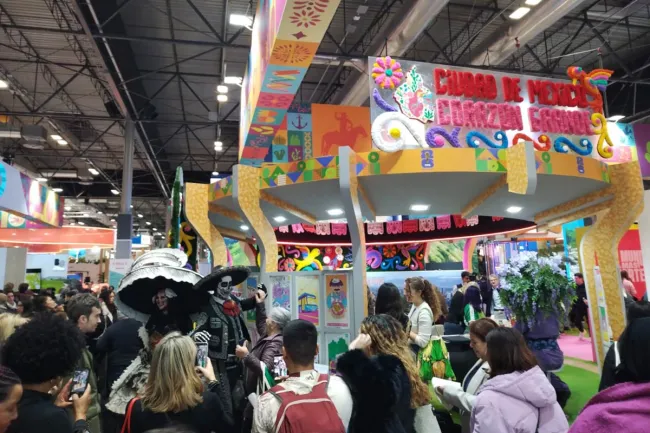
Alejandra Frausto Guerrero, head of the capital’s Tourism Secretariat, stated during the opening ceremony that Mexico City arrives at FITUR 2026 with an open heart: “We are a cultural, creative, and welcoming capital, ready to receive the world on the road to the 2026 World Cup and to share a city that is lived, celebrated, and remembered.”
With this participation, Mexico City reaffirms its role as Latin America’s cultural, creative, and tourism capital, and as one of the leading protagonists of global tourism toward 2026— a city that welcomes the world with a big heart, ready to share its history, its energy, and its future.
FITUR, for its part, confirms its role as a driver of Madrid’s economy, with an economic impact reaching €505 million, reaffirming its pulling power and surpassing 255,000 attendees.
For 2027, Puerto Rico will be the Guest Partner Country.