
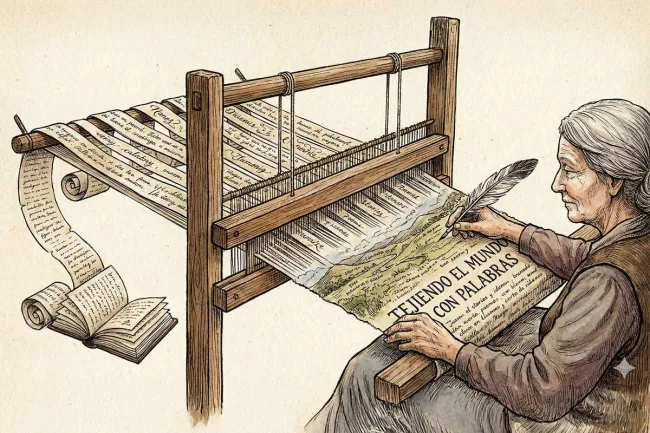
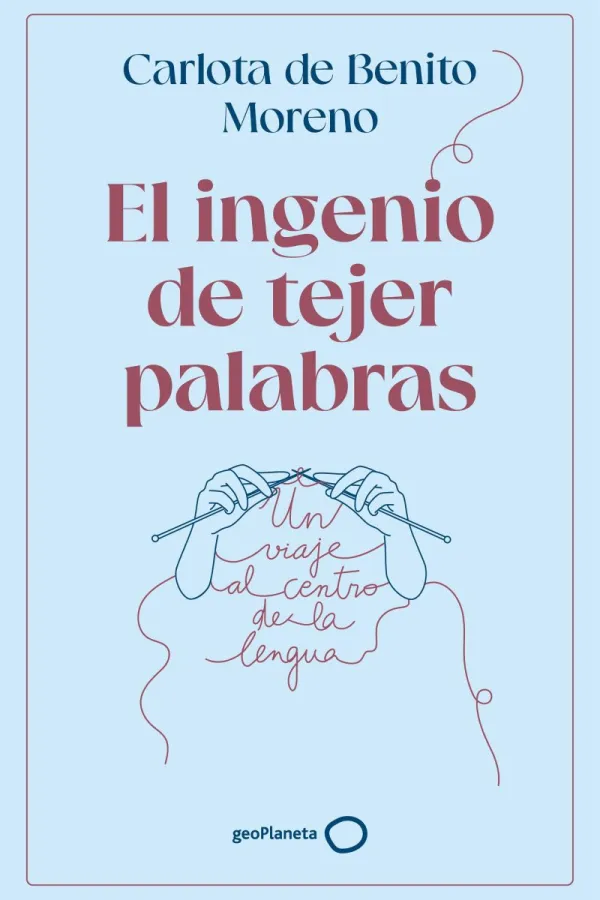
The book El ingenio de tejer palabras (word-weaving ingenuity) by linguist Carlota de Benito Moreno is more than just a book; it's an experience. This isn't a collection of grammatical rules; it's filled with humor, stories, and a few surprises. The author invites the reader to discover together that there's a logic behind language.
De Benito Moreno transforms the perception of grammar as a dry subject, presenting it as a fascinating tool that allows us to understand how we think, reason, and communicate.
What's the story behind "haiga," "sabo," and other irregular forms? What connects in our brains when we conjugate verbs? What mistake does Ana Torroja make when she sings "La fuerza del destino"? Is it really so wrong to say "habrán crises"?
A journey through Spanish across time and space. The writer explores the diversity of Spanish: how it changes according to the era, the place, or the social group. From the "voseo" of the Río de la Plata region to youth slang, the book shows that every linguistic choice is a reflection of cultures and realities.
“I intend this book to be a three-part journey: first, a journey through Spanish and its rules; second, a journey through that ‘language lobe’ of our brain, because by comparing different ways of saying the same thing—that is, different rules of Spanish from different places—we can understand the mental mechanisms necessary to arrive at one form or another; and third, a journey through the territories where Spanish is spoken in different ways. I will focus primarily on the Spanish of Spain, which is the one I know best, but sometimes we will cross the Atlantic to reach the Americas. As it is a travel book, at the very end you will find a short dialect guide to Spain, which you can consult before traveling through our country. The journey will not be by plane, but through examples, many examples. You will soon discover that linguists navigate among examples, which we sometimes recreate and sometimes extract from compilations of texts, which we call corpora, or even from linguistic atlases, which were patiently created by asking locals about their way of speaking,” says Carlota.
In the prologue to this book, journalist and writer Rubén Amón defines it as “an elegy to error. To that ‘mistake’ which is nothing more than the seed of change. Carlota reminds us that language doesn’t make mistakes: it evolves. That what is a slip today will be the norm tomorrow. That the history of language is the history of its deviations, as happens in the history of art. An accident opened the path of the avant-garde for Jackson Pollock.”
The author
Carlota de Benito Moreno is a linguist. She studied Law and Hispanic Philology at the Autonomous University of Madrid, where she earned her doctorate in the latter with a dissertation on reflexive verbs in the varieties of Galician, Asturian, and Peninsular Spanish. Her family and friends were surprised that the topic warranted a thousand-page thesis, but among her fellow linguists, hardly a eyebrow was raised. She dedicates herself to the study of language; she spent more than ten years at the University of Zurich and now works at the Autonomous University of Madrid.
What fascinates her about languages is how they change, whether through time, space, or across different social groups, and she typically studies this in two seemingly disparate areas that, nevertheless, provide her with equal satisfaction: rural Spanish speech and the written language of social media. Her outreach work began with a blog, called "Se me va de la lengua" (I'm letting my tongue run away), an incomprehensible number of years ago, and in 2022 she co-edited the book "Como dicen en mi pueblo. El habla de los pueblos españoles" (As they say in my town. The speech of Spanish towns) with her colleagues Ana Estrada and Beatriz Martín.