
Goya and his Caprices
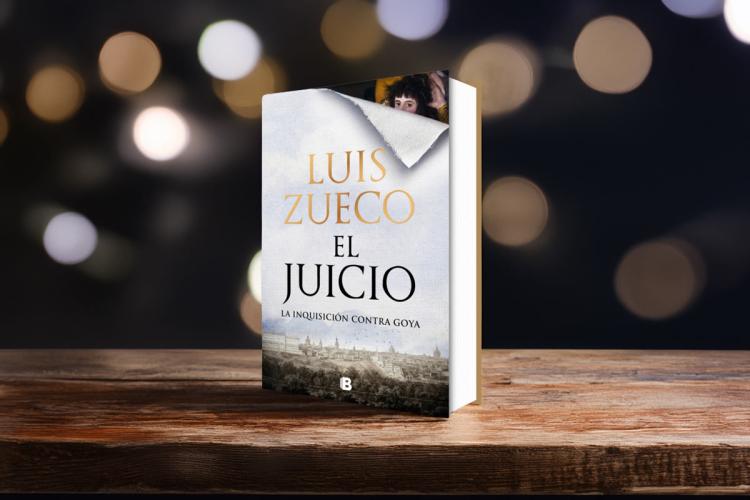
The master of the historical novel returns, Luis Zueco publishes his recent book The Trial, an enveloping intrigue through one of the most unknown and fascinating episodes in the life of the painter Francisco de Goya y Lucientes.
LinkMyriam BO
In this book, the author reflects on art as an instrument for changing history. It is a vibrant and extraordinarily well-documented text that poses the questions: Can a painter judge the world? Can the world judge a genius?
In Madrid in 1799, Goya, court painter to the king, publishes a book of eighty enigmatic images entitled Los Caprichos (The Caprices). The content of its pages—a sharp critique of the society of the time, of the credulous populace, of the nobility, and of the clergy—begins to spread through the city like wildfire. The scandal reaches the ears of the Holy Inquisition, an institution already in decline, which decides to confront someone as celebrated and respected as Goya to demonstrate that it still wields enormous power. Meanwhile, Angélica Diez arrives at court fleeing a dark past and goes to Goya to have her portrait painted. Despite his long waiting list, the master agrees on one condition: she must also pose for a secret commission from a powerful politician. The painting will go down in history as The Nude Maja. Soon, the artist and his mysterious model will find themselves caught in a relentless chase, rife with conspiracies and mysteries, through the streets and palaces of Madrid.
“The Caprichos are one of the most courageous works in the history of art. Goya is not only a genius. He is a committed man who denounces vices, inequalities, and injustices. He risks everything to change society and achieve a better and freer world.
In my opinion, in 1799 Goya still had enough influence to avoid falling into the hands of the Inquisition. Furthermore, he acted very quickly and officially withdrew all copies of the Caprichos from sale. However, the matter became more complicated years later. Therefore, in 1803, Goya decided to hand over the copies of the Caprichos he had kept (two hundred and forty books) and the copper plates to the king, a shrewd move that allowed him to save his work and also obtain a pension for his only son, Francisco Javier, the only one who survived him. On October 6, 1803, the Royal Calcography put them back on sale, as evidenced by a new advertisement, this time in the Gazette of Madrid, and shorter than the original. By the end of 1803, they were back on sale without any censorship.
"It was a masterful move that reveals the Aragonese man's shrewdness, especially considering he was completely deaf," the author notes.
The author
Luis Zueco, originally from Zaragoza, is the director of the Castles of Grisel and Bulbuente, two restored fortresses converted into charming accommodations and event venues. He is also an industrial engineer, holds a degree in History and a master's degree in Artistic and Historical Research, is a member of the Spanish Association of Friends of Castles, and contributes as a heritage and culture expert to various media outlets. Zueco has achieved international critical and popular acclaim with his captivating Medieval Trilogy: The Castle, The City, and The Monastery. His subsequent books, all published by Ediciones B, have established him as one of Spain's most important novelists. According to the author himself, The Trial is his most ambitious novel, since it pays homage not only to Goya as a genius but also to "a committed man who denounces vices, inequalities, and injustices. Who risks everything to change society and achieve a better and freer world."