
His first exhibition was in his hometown in 1980. He has worked in Berlin, Brussels, England, France, and the United States. He currently lives and works in Barcelona.
He has taught at the École Nationale Supérieure des Beaux-Arts in Paris and regularly collaborates with the School of the Art Institute of Chicago as a visiting professor. He has also given numerous lectures and courses at other universities, museums, and cultural institutions around the world.
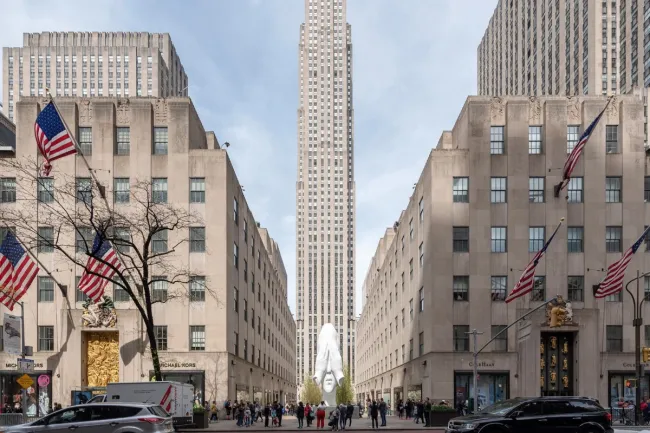
Jaume Plensa has received numerous awards and recognitions, including the Marsh Award for Excellence in Public Sculpture, which he received in London in 2009 for his work Dream. In 2019, he received special recognition for Behind the Walls (2018) at the Rockefeller Center in New York, which traveled to the MUNAL – National Museum of Art in Mexico City, and in 2020 was installed at the University of Michigan Museum of Art in Ann Arbor, Michigan, USA.
In 2025, he entered the Royal Academy of Fine Arts of San Fernando in Madrid with the speech From the "I" to the "We." The Corporation's response was delivered by historian Víctor Nieto.
Plensa's candidacy as a full member of the Sculpture Section was presented in 2022 by sculptor Juan Bordes Caballero and professors Simón Marchán Fiz and Víctor Nieto Alcaide. For more than four decades, the work of this integral artist has stood out for the diversity of its forms of expression, whether large-scale sculptures, public commissions, sets and costumes for opera and theater, or the more intimate aspects of his work, comprised of drawings, prints, artist's books, and multiple works on paper. This creative plurality, as well as the meanings that permeate his work, are part of a strategy of redefining artistic functionality, articulated around the sign, the word, and the body. His sculptures exude a visual sense of ataraxia, of beautiful, classical serenity.
From "I" to "We" represents the universality of Plensa's work, the two-way journey between the individual and the community, the exaltation of beauty as "the bond that unites us to everything and everyone," a "place" of encounter. The new academic has defended the importance of art in our time, the need to create an environment of light and beauty in everyday life. His speech, like his work, is a plea for hope, for active, conscious participation, trusting in the "great regenerative capacity of beauty as an instrument that transforms and illuminates the community, filling it with hope." To this end, he emphasizes the importance of each individual finding and developing their capacity for growth.
Throughout his life and work, he has created bonds between diverse people and communities, making us part of that community fabric that stems from the deepest part of the self, to confront, as a therapy—in Nieto's words—one of the ills affecting human beings in our time: loneliness surrounded by a crowd.
Using the metaphorical image, where the letter may seem insignificant, but when united with others, it forms words, and these form texts, thoughts, culture... in an exponential concatenation comparable to the evolution of cells in more complex organisms, made possible by collaborations, unions, and connections, evolution is fostered: "The permanent transformation of the Self into We."
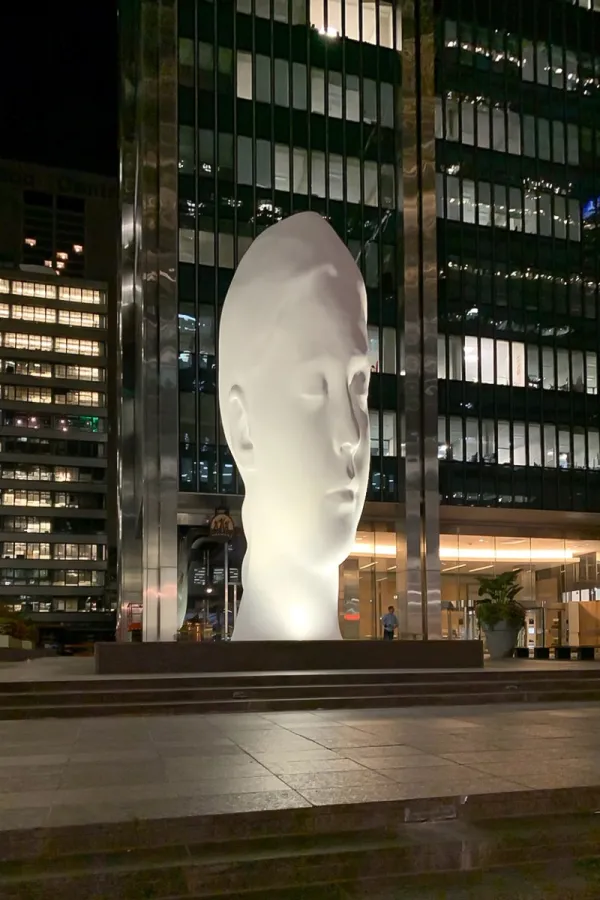
Plensa's sculptures generate a relationship with the space and the spectators. Currently, since 2018, a twelve-meter sculpture called Julia can be enjoyed in Madrid's Plaza de Colón. With the sponsorship of the María Cristina Masaveu Peterson Foundation and the collaboration of the Madrid City Council, they have renewed the agreement so that this unique work of art remains on display in the Spanish capital until December 2025 (extendable for two more years, until December 2027). It sits on the pedestal formerly occupied by the statue of the Genoese navigator.
In the words of its creator, Julia aims to provoke "a moment of personal and intimate reflection within the hectic dynamism generated by public space."
Plensa is an artist of materials, sensations, and ideas, and his references range from literature and poetry to music and thought.
With the admission of Jaume Plensa, the Royal Academy of Fine Arts of San Fernando in Madrid incorporates a great sculptor of international renown and a committed artist. Silence, peace, tranquility, beauty, knowledge, introspection, hope, respect, humanity, and nature... "sculpture is that place to which we can always return."
Plensa regularly exhibits his work in galleries and museums in Europe, the United States, and Asia. Among the most emblematic exhibitions of his career is the one organized at the Fundació Joan Miró in Barcelona in 1996, which traveled to the Galerie nationale du Jeu de Paume in Paris and the Malmö Konsthall in Malmö, Sweden, the following year. In Germany, several museums have exhibited his work. During 2015 and 2016, the exhibition Human Landscape traveled to several North American museums: Cheekwood Estate and Gardens and The Frist Center for the Visual Arts in Nashville, TN; the Tampa Museum of Art in Tampa, FL; and the Toledo Museum of Art in Toledo, OH. In 2022, the Musée d'art moderne de Céret in Céret, France, inaugurated its new spaces with "Chaque visage est un lieu." A significant portion of Plensa's work focuses on sculpture in public spaces. It has been installed in several cities in Spain, France, Japan, England, Korea, Germany, Canada, the United States, and more.
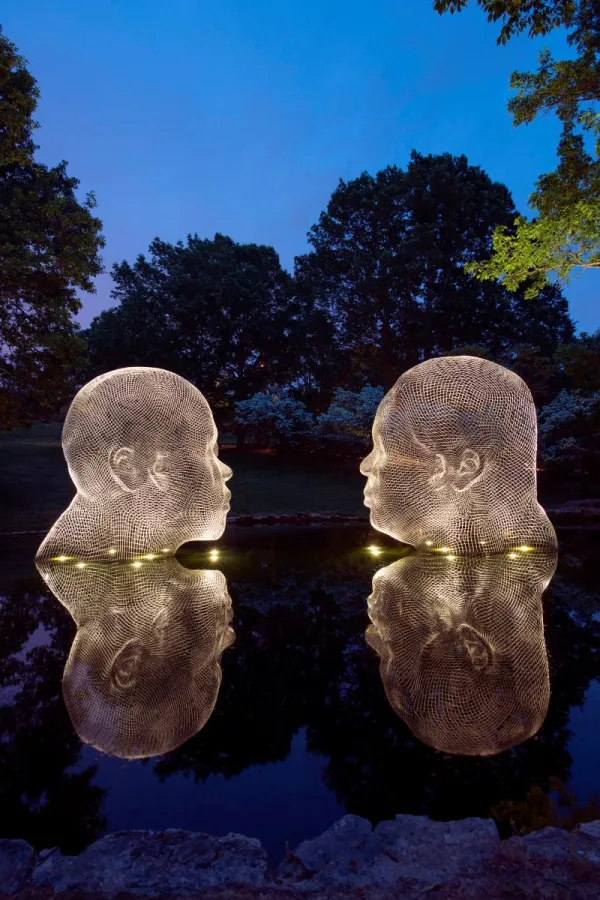
In the United States, where Plensa has worked and exhibited for nearly three decades, his works have been displayed in numerous art galleries and museums. Among his most notable exhibitions is the one organized at the Nasher Sculpture Center in Dallas.
In 2011, a large selection of Plensa's sculptures was exhibited at Yorkshire Sculpture Park in West Bretton, England. The extensive exhibition was presented in the galleries and the park. Thanks to this exhibition, the site received national recognition as Most Magnificent Attraction in 2011.
Jaume Plensa's work can be seen regularly at Galerie Lelong & Co in Paris and New York, and at the Richard Gray Gallery in Chicago and New York.