
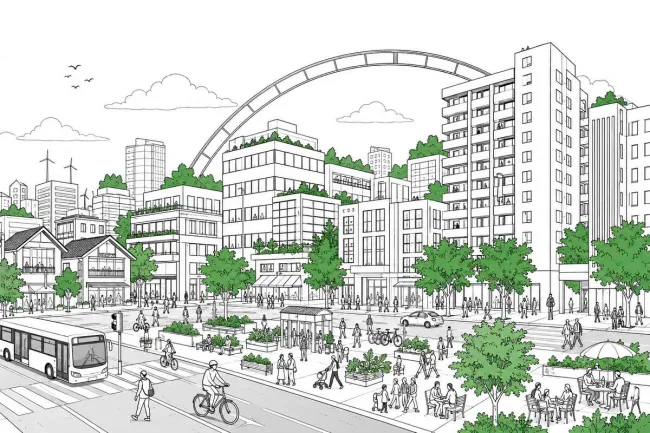
The author starts from a premise: the urban crisis is not measured only in traffic, emissions or housing, but also in time lost. The question running through the book is not how to move faster, but what we ought to have close at hand so as not to spend our lives travelling. That reversal of perspective is what makes La ciudad de los 15 minutos such a newsworthy proposition: it is about urban planning, but also about health, childhood, care, local shops, energy, community participation, technology and the wish to live better.
This book tells the story of turning a complex urban problem into a formulation that is comprehensible, desirable and politically workable.
Living with dignity
The opening chapters trace the evolution of the modern city, from Le Corbusier's functionalism and the rigid separation of uses through to the geography of urban time.
La ciudad de los 15 minutos is a book for understanding one of the central arguments of contemporary life: what kind of city we want to live in, now that time, air, health and neighbourhood ties have become political matters. It is also a concrete way of discussing the green transition without reducing it to abstraction or sacrifice.
The promise the book holds out is more direct: recovering proximity can mean recovering time, daily life and the city itself.
Moreno made Paris the focus of urban action under Anne Hidalgo's administration; the C40 network took up the idea in July 2020, and the debate now appears in reports and recommendations from bodies such as UN-Habitat, the IPCC, the WHO and UCLG. From there, La ciudad de los 15 minutos travels to Milan, Portland, Cleveland, Buenos Aires, Susa, Melbourne, Busan, Scotland, Île-de-France and small municipalities that have adapted the idea to very different scales and contexts.
This is not a local debate or a Parisian fashion: it is one of the ways cities are naming their future.
This is neither a technical manual nor an abstract manifesto, but an essay written to intervene: it explains where the fragmented city inherited from the twentieth century came from, why a model based on separating functions and depending on the car has stopped meeting our needs, and how proximity can connect the green transition with an improvement in everyday life. The book works as genealogy, as diagnosis and as a map of solutions.
The closing stretch turns to digital tools, territorial information and artificial intelligence as allies of the proximate city. Moreno does not present technology as a substitute for urban policy or for community participation; he presents it as a means. The involvement of residents proves decisive. He is insistent that proximity cannot be decreed from above as a fixed template. It needs data, certainly, but also real patterns of use, community ties, negotiation over resources and an idea of the common good capable of addressing inequality, gentrification and territorial divides.
The author
Carlos Moreno was born in Colombia in 1959 and has lived in France since 1979. He is a professor and researcher, and scientific director of the "Entrepreneurship, Territory and Innovation" Chair at IAE Paris Sorbonne. He has advised senior politicians and professionals across the world; in 2019 he received the Prospective medal from the French Academy of Architecture; he is a member of the American Academy of Housing and Communities and of Sigma Xi, and he has been awarded France's National Order of the Legion of Honour.