

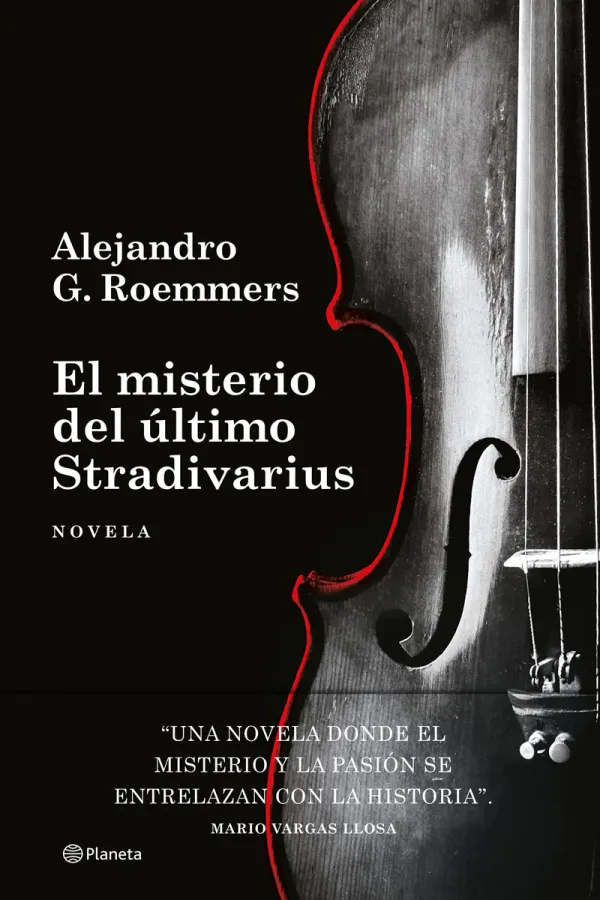
The Mystery of the Last Stradivarius by Alejandro G. Roemmers is a read for lovers of music, travel, and mystery. An extraordinary thriller with flashes of magical realism that, following the tradition of so-called "object literature," connects lives, music, and magic throughout history.
Through his pen, the Argentine poet follows the fate of the last violin made by the famous Antonio Stradivari in the 18th century, while recounting the intriguing investigation of a double murder in a small town in Paraguay. The true protagonist of this thrilling adventure is a unique violin, a legendary musical instrument endowed with an aura of mystery capable of determining the fate of its owners. Past and present intertwine in an original detective novel with historical and fantastical overtones that plays with reality and fiction to captivate the reader from the first page to the last.
The prologue is by Mario Vargas Llosa, who states, “As a longtime classical music fan, I have enjoyed seeing the violin, one of the most beautiful musical instruments, become the protagonist of a fictional work. I am sure that readers, whether interested in music or not, will appreciate this new novel by Alejandro Guillermo Roemmers.”
Synopsis
An antique dealer and his teenage daughter are found dead with signs of violence in their home in Areguá, a town near Asunción, Paraguay. Commissioner Tobosa and Sergeant Gutiérrez, unaccustomed to events of this magnitude, go there. But the big surprise is not only the crime scene, but the large number of antiques and works of art they find in the house. However, the most striking thing is precisely what is missing: a missing Stradivarius violin. From that moment on, the investigation continues, tracing the legendary violin's history from its creation and who owned it, until it reached the hands of the murdered antique dealer.
A fascinating novel that follows the journey of the last Stradivarius over three centuries and transports the reader to historic moments.
Origin of the Novel
This entirely imaginary story is based on real events: the murder of the German scientist, archaeologist, and musician Bernard Raymond von Bredow and his fourteen-year-old daughter, Lorena Lydia Von Bredow, which occurred on October 22, 2021, at their home in Areguá, a few kilometers from Asunción, Paraguay. The murder was related to the theft of Stradivarius violins from their property. The novel is based on this event.
A Journey Through Different Settings
Throughout the reading, the journey of the majestic violin is followed from its creation in the city of Cremona in the 18th century to the present day in Paraguay, passing through Naples, a victim of the plague, Venice and the Napoleonic invasion, Trieste, and Rome.
Each of the places described not only provides context for the story, but also brings together meaningful stories, taking readers on a journey through the streets of Cremona alongside Antonio Stradivari and his eldest son (admirers of the Cathedral of Santa Maria Assunta).
The unique universe the author masterfully creates uses, in both plots, the marvelous power of the violin and its music. Everyone desires to possess it because, thanks to it, they will be protected and survive the evil that stalks them.
The novel addresses themes such as human evil and goodness, justice, the beauty of art, peace, the search for truth, and the meaning of our existence. In Roemmers' words: "Far from any kind of vindication that anyone might imagine, I wanted to highlight the capacity of art, and in particular, of music, to heal the wounds of the soul and elevate human beings and their destiny above the passions of beasts."
The poet and playwright
Alejandro G. Roemmers was born in Buenos Aires in 1958. He has collaborated on various projects promoting fraternity and peace throughout the world. He has received numerous international awards for his work, including the San Francisco de Asís Award, awarded by the Vatican to a lay person for the first time in eight hundred years. In 2025, he was appointed Ambassador for Peace by the World Organization for Peace (WOFP). He has published the books "Vivir se escribe en presente" (Living is Written in the Present), "Morir lo necesario" (Dying the Necessary), "El regreso del Joven Príncipe" (The Return of the Young Prince), and "El Joven Príncipe points the way" (The Young Prince Points the Way), the latter two translated into thirty languages and with over three million copies sold. He has written the musicals "Franciscus, una razón para vivir" (Franciscus, a Reason to Live) and "Regreso en Patagonia" (Return in Patagonia), as well as numerous collections of poetry.