
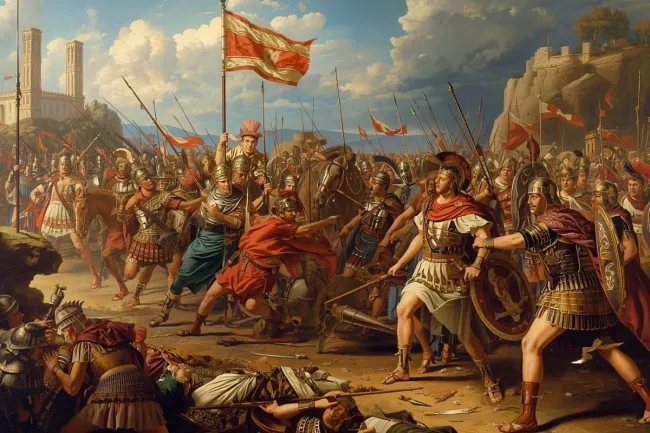
Santiago Posteguillo's new novel, The Three Worlds (Los tres mundos), is now available in bookstores across Latin America, Spain, and the United States. With this latest work, he continues his ambitious literary project of fictionalizing the life of Julius Caesar. In this new installment, he masterfully narrates the conquest of Gaul.
In the novel Rome Is Me, the origins of Julius Caesar are revealed, and in Cursed Rome, the reader witnesses his rise to power. Now, Caesar faces the famous Gallic Wars, from which he emerged militarily victorious, while a young Cleopatra accompanies her father in exile. With meticulous research and a superb pace, this vigorous historical epic recreates one of the most significant feats of all time. A monumental challenge, an indomitable ambition, and the heat of war converge in these epic pages, which culminate the Rise Trilogy, the first cycle of the series about Julius Caesar.
If in Rome is me we learned about the origins of Julius Caesar, and in Cursed Rome we witnessed his political rise, now Julius Caesar faces one of the greatest historical challenges of all time: the conquest of Gaul, a territory always hostile to Rome, vast, immense, and, in the eyes of Caesar's enemies, an unconquerable place destined to be his tomb. With meticulous research and a superb pace, we experience the suffering and epic nature of the Gallic Wars, but we also witness the fratricidal political struggle in Rome and travel into exile with Pharaoh Ptolemy XII, expelled from Egypt in the company of his daughter, the young and mythical Cleopatra. In 58 BC, Rome, Gaul, and Egypt were three distinct worlds that, unknowingly, were heading toward a single destiny.
In 58 BC, Julius Caesar fights in Gaul against the Germanic king Ariovistus; In Rome, Clodius rules as he pleases, representing the triumvirate of Pompey, Crassus, and Julius Caesar, the latter absent from the city. In Egypt, Berenice IV governs after deposing her father, Ptolemy XII, who has gone into exile in Rome with his youngest daughter, the future Cleopatra VII. These three worlds are marching toward a single destiny. Gaul, Rome, and Egypt: an inexorable collision of three legendary worlds that culminates the Trilogy of the Ascent, the first cycle of the series about Julius Caesar.
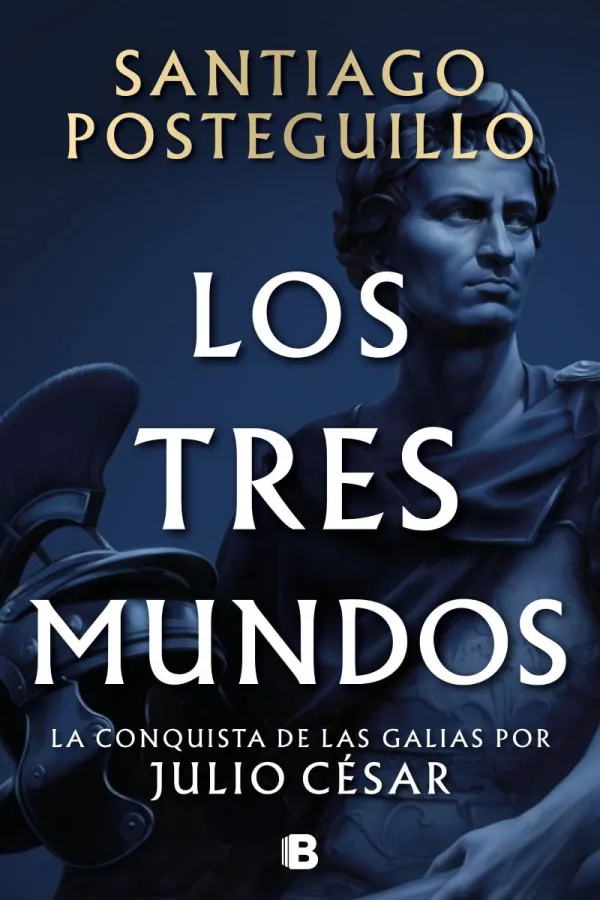
With this third novel, Santiago Posteguillo concludes the first cycle of the saga, in which the reader has witnessed Julius Caesar's rise to political and military power. The first two novels of this ambitious project have reached over half a million readers, consistently ranking among the top bestseller lists in Spain and Latin America. The saga is now a global success, with translations into more than ten languages: English, German, Italian, Portuguese, Arabic, Russian, Polish, Croatian, Lithuanian, and Czech.
Julius César series by Santiago Posteguillo
The author is the best-selling author of historical fiction in Spanish, with over 5,000,000 readers.
The author
Santiago Posteguillo, PhD from the University of Valencia, is currently a tenured professor at Jaume I University in Castellón. He has studied creative writing in the United States and linguistics and translation at various universities in the United Kingdom. In 2006, he published his first novel, Africanus: The Son of the Consul, the first in a trilogy that continued with The Cursed Legions and The Betrayal of Rome. He is also the author of the Trajan Trilogy, comprised of The Emperor's Assassins, Circus Maximus, and The Lost Legion.
Posteguillo received the Valencian Generalitat Literature Prize in 2010, the Barcino Prize for Historical Novels in Barcelona in 2014, and in 2018, he was awarded the Planeta Prize for his novel Yo, Julia, which was followed by Y Julia retó a los dioses in 2020. In addition, in 2018 he was a visiting professor at Sidney Sussex College, Cambridge University.