
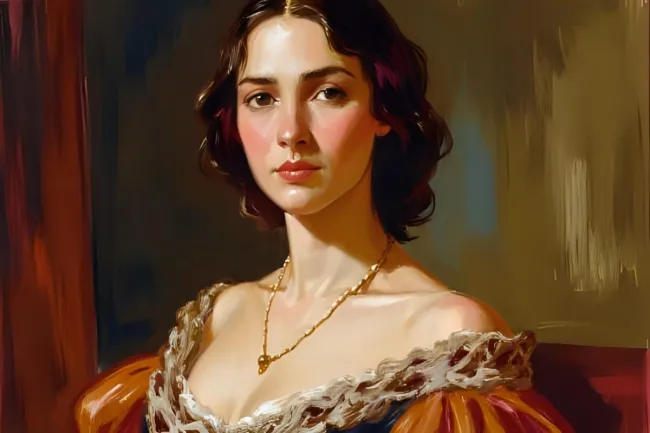
Carlos del Amor's recent book, An Unknown Lady, revolves around the figure of a woman's face painted on a painting owned by a collector named Prosper, who claims it is a work by the Sevillian painter Velázquez.
The idea for this novel began when the author received a real email. The sender was Santi, an art historian, speaking on behalf of Prosper, who claimed he had a painting depicting Juana Pacheco, the painter's wife, and provided evidence to validate his claim. The collector sought expert authentication of the painting, which he purchased at auction.
After several conversations with Santi, this unknown lady becomes an obsession for Carlos del Amor.
The reader will learn about the research on the painting, but will also delve into Velázquez's life from his childhood to his becoming the court painter of Philip IV. The author begins to imagine what Velázquez would have been like as a young boy, an apprentice in Francisco Pacheco's Seville studio, and in love with Juana, his master's daughter and his first muse.
A painter of whom little is known, the reader will embark on a journey to Madrid, to the Court, or to Italy, where the creator of Las Meninas will complete his training. It is in the Spanish capital where his talent shines, opening doors to the most important houses and also to the King, who makes him his favorite painter and confidant.
Through the pages of An Unknown Lady, forgotten female figures in the art world, such as Pacheco, are discovered.
The reader will also visit grand museums, dusty archives, restoration workshops, collectors' corners, and glamorous auctions. The goal is to find definitive evidence to authenticate the alleged Velázquez. This is no easy task, as the path is winding, with false leads, divergent theories, and very fragile evidence.
This book is a fusion of literary genres and an experiment, in which historical fiction and journalistic investigation merge with personal chronicles. Del Amor states, "But I don't know if this is a love story, or even if it's a novel or an insight into the figure of a character determined, it seems, to leave no trace beyond his art. It's either an essay or a reflection of someone's obsession with a painting, or a simple, frustrated detective story."
The writer, by becoming another character in the story, raises several fundamental questions: Who decides the authorship of a painting and who decides the value of an artist? What does art give us? How does art reflect the pasado? ¿Cómo consigue el éxito? ¿Cuánto talento se queda en el camino?
About the author and cultural journalist
Carlos del Amor was born in Murcia in 1974. He holds a degree in Journalism from the Carlos III University of Madrid and a diploma in Documentation from the University of Murcia. His journalistic work, always linked to RTVE and focused on culture, is well-known.
A regular journalist at the world's most important film festivals, he is considered one of the most important voices in cultural journalism in Spain. He has won several international awards for his documentary Revealing Dalí. He recently directed the series The Mathematics of the Mirror. He has given talks and lectures at numerous universities.
In 2013, he made his literary debut with the collection of short stories Life Sometimes; one of those stories, The Storage Room, was adapted into a film. In 2015, his first novel, The Year Without a Summer, was published, and in 2017, Confabulation.
Mocionarte. The Double Life of Paintings won the 2020 Espasa Award. In 2022, he published Retratarte.