
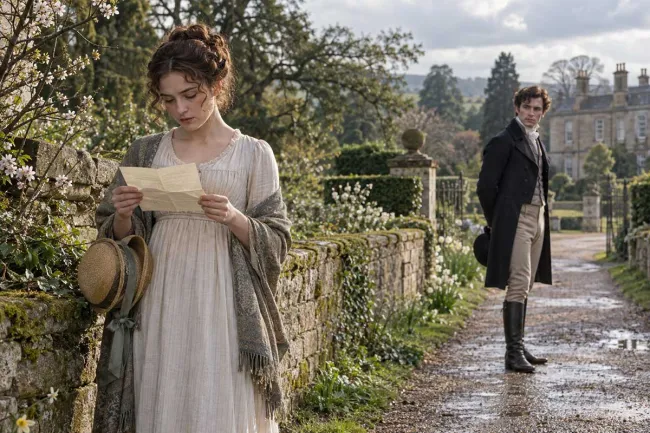
Few novels carry as much baggage as Pride and Prejudice. Two centuries of adaptations, tote bags printed with Austen quotes and romantic comedies built on its bones have fixed the image of a drawing-room novel, all balls, glances and a predictable ending. The image is not wrong, but it leaves out the essential point: this is, above all, a comedy, and a fairly sharp one.
The premise is simple. Mrs Bennet has five unmarried daughters and a single obsession: getting them wed. It is not a whim. The family home can only pass to a male heir, so when their father dies it will go to a distant cousin, leaving the daughters without a roof or an income. Elizabeth, the second daughter, meets Mr Darcy at a ball: wealthy, aloof and convinced that nobody in the room is worth his attention. The dislike is instant and mutual. What follows is the story of two people who take hundreds of pages to admit they misjudged each other. Tellingly, Austen's original title for the novel was First Impressions.
The real achievement is the voice. Austen was one of the first novelists to master free indirect discourse, a technique in which the narration slips into a character's thoughts without announcing it. The reader sees the world through Elizabeth's eyes while sensing where she is going wrong. She is clever, funny and quick with a reply, which is exactly why her mistakes are so convincing. The novel laughs with her and, at times, at her.
Beneath the witty exchanges lies a very material concern: money. Elizabeth's friend Charlotte Lucas agrees to marry an absurd clergyman, the same cousin set to inherit the Bennet home, because at twenty-seven and without a fortune, marriage is her only security. Austen does not condemn her; she lets the decision sit uncomfortably. That frankness about the cost of being a woman without means is what stops the book from ageing into a simple love story.
Its descendants are countless. Helen Fielding's Bridget Jones's Diary moves the plot to 1990s London and even names its leading man Mark Darcy. The enemies-to-lovers formula, now everywhere in romantic fiction and social media reading recommendations, finds one of its finest models here. It is worth separating the book from its adaptations, though: the famous scene of Colin Firth emerging from a lake in a soaked shirt, from the 1995 BBC series, appears nowhere in the novel.
A less obvious connection leads to The House of Bernarda Alba, the last play by the Spanish poet and dramatist Federico García Lorca. Lorca, too, puts a mother and five daughters on stage, their fate bound up with marriage. What Austen resolves with irony and dancing, Lorca turns into confinement and tragedy. Read side by side, the two works show opposite faces of the same problem: one in the light of the drawing room, the other behind closed doors.
Not everything is equally accomplished. Towards the end, a family scandal is resolved by a providential intervention that happens almost entirely offstage, and the tension slackens just when it matters most. Some of the supporting cast, starting with Mrs Bennet herself, never rise above caricature, however entertaining.
Even so, few novels written two centuries ago read so fluently. The sentences are long but clear, the dialogue has the timing of good comedy and the short chapters keep the pages turning. It also leaves a lesson its reputation tends to obscure: first impressions are rarely the final word, not even with Jane Austen.
About the author
Jane Austen (Steventon, England, 1775 – Winchester, 1817) wrote six complete novels. The four published in her lifetime appeared without her name: Pride and Prejudice came out in 1813 credited simply to "the author of Sense and Sensibility". She died at forty-one, never knowing the fame that would follow. Today her portrait appears on the £10 note, and her novels are adapted again and again. For many younger readers, the 2005 film starring Keira Knightley has been the way into the book.