
This exhibition is worth an hour of anyone's afternoon.
I will admit that the first time I heard the phrase 'the Columbian Exchange' I assumed it was a bank. It is not. It is the name historians give to what happened after 1492, when two halves of the world that had been apart for thousands of years were suddenly joined by ships, and everything on them started to move.
That is the subject of Arcadia, the latest film installation by John Akomfrah, which opened at London's Natural History Museum on Friday 6 November. It is free, it runs until May 2027, and it sits a few steps from a gallery full of the very specimens its story is about.
The good news, if you are in London or passing through, is that you do not need to know any of the history to walk in. The film does the telling. This article is for the moment afterwards, when you want to know what you have just seen.
What Arcadia is
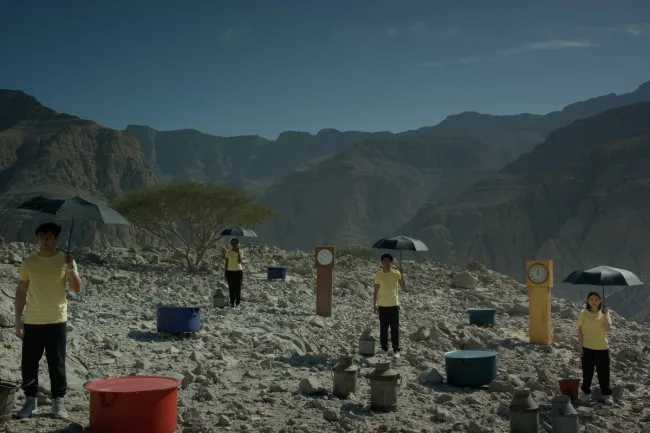
Arcadia is a film shown on five large screens arranged in a cross, with sound that surrounds you. It lasts just under an hour and plays on a loop in the museum's Jerwood Gallery, so you can arrive at any point and stay as long as you like.
The images are landscapes first: deserts, ice fields, mountains, storms, coral reefs, ruins swallowed by forest. Then they are interrupted. Cargo, decaying ships, symbols of trade and disease cut across the beauty, and past and present run side by side on different screens. The soundtrack mixes nature recordings with opera and poetry.
Akomfrah made the piece in 2023, in the wake of the pandemic, and it was first shown at the Sharjah Biennial that year before a UK premiere at The Box in Plymouth. This is its London debut. He has said he wanted to go back to a time before the guns came out, to look at the other forces, intended or not, that were also at work.
Who John Akomfrah is
If the name is new to you, it will not be for long. Akomfrah was born in Accra in 1957 and grew up in London, where in the early 1980s he co-founded the Black Audio Film Collective with Lina Gopaul and David Lawson. Their 1986 film Handsworth Songs, about the riots in Birmingham and London, established the layered, archive-rich style he still uses.
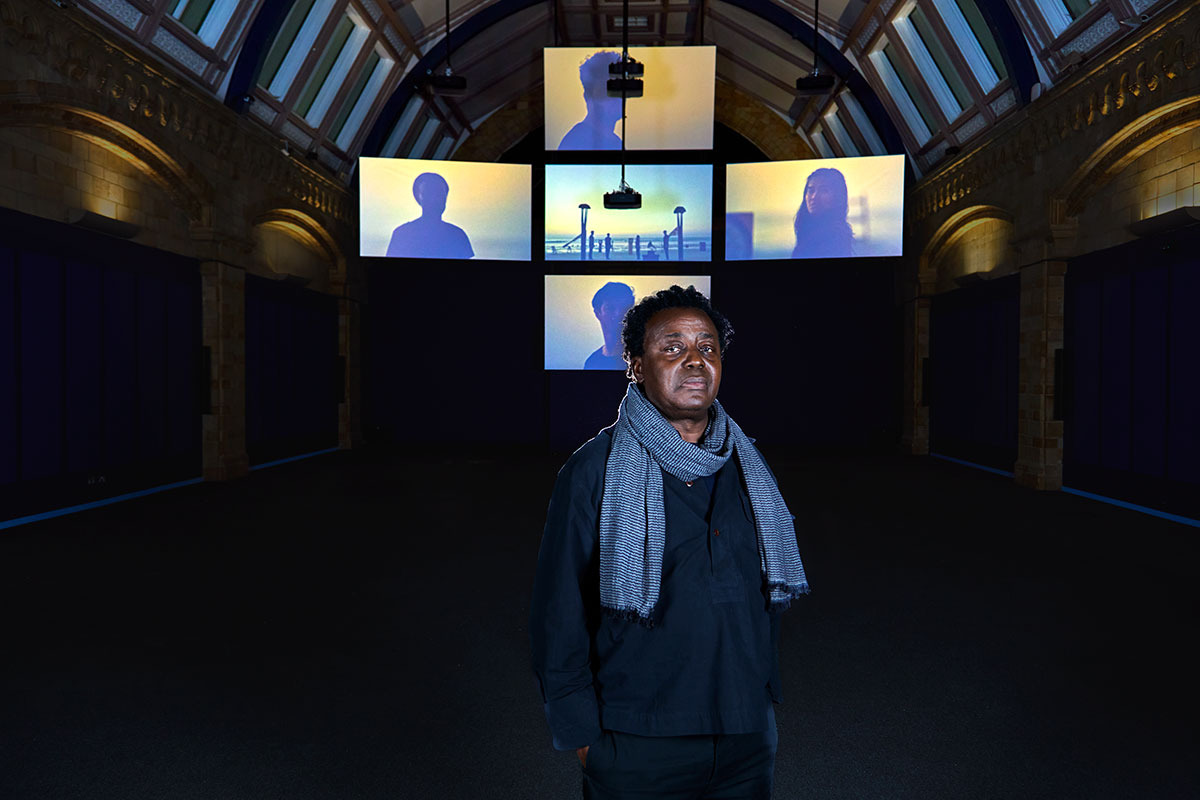
Since then he has made some of the most admired film installations in British art: Vertigo Sea (2015), on whaling and the ocean; Purple (2017), on climate; and in 2024 Listening All Night to the Rain, which filled the British Pavilion at the Venice Biennale. He was knighted in 2023 for services to the arts, so strictly it is Sir John.
What the Columbian Exchange actually was
Here is the history in short. Before 1492, the Americas and the rest of the world had been biologically separate for roughly 12,000 years. Different crops, different animals, different diseases. Columbus's voyages, and the thousands of ships that followed, undid that separation in a few decades.
The term was coined in 1972 by the American historian Alfred W. Crosby, who argued that the transfer of living things was at least as important as the gold. Think of it as three traffic lanes:
- Plants. Maize, potatoes, tomatoes, chillies, cacao, tobacco, cassava and peanuts went east. Wheat, sugar cane, coffee, rice, bananas and citrus went west.
- Animals. Horses, cattle, pigs, sheep, goats and chickens crossed to the Americas, where there had been almost no large domestic animals. The turkey went the other way.
- Diseases. Smallpox, measles, influenza and typhus travelled with the sailors. Indigenous peoples had no inherited resistance, and the population of the Americas is estimated to have fallen by 90 per cent or more within a century or two. It is one of the largest losses of human life in history.
The effects are still on your plate. There was no tomato in Italy, no chilli in India, no potato in Ireland and no chocolate in Switzerland before the Exchange. The potato alone helped drive the population growth of northern Europe after 1750.
We tend to teach it as a list of crops, which makes it sound tidy. It was closer to a slow planetary earthquake: the soil, the forests, the animals and the people of four continents were all rearranged, and the arrangement we live in now is the one that settled.
Why a film, and why this museum
That is the question I asked myself on the way in. You could read all this in a book. What a five-screen film adds is scale and simultaneity. A map shows you a route; Arcadia shows you a storm, a shipwreck, a reef and a line of cargo at the same moment, and lets your eye make the connections a textbook spells out.
The setting matters too. The Natural History Museum holds more than 80 million specimens collected over 300 years, including material from Darwin's voyage on the Beagle. Those collections are themselves a product of the age of sail and empire that Arcadia depicts. Akomfrah has said he hopes the museum's audiences will see the film's journeys in dialogue with the journeys already inside the building.
Alex Burch, the museum's Director of Public Programmes, calls Akomfrah one of the most significant artists working today, and says the piece invites visitors to consider how migration, trade and empire shaped people and planet alike.
Practical details
- Where: Jerwood Gallery, Natural History Museum, Cromwell Road, South Kensington, London SW7 5BD. South Kensington tube (Piccadilly, District and Circle lines) is a short walk through the pedestrian tunnel.
- When: 6 November 2026 to May 2027. The museum opens daily 10.00 to 17.50 and is closed 24 to 26 December.
- Cost: free. The exhibition itself needs no ticket, but the museum recommends booking a free general-admission ticket online for guaranteed entry on busy days. Members walk straight in.
- Length: just under an hour, on a loop. Allow 30 minutes if you are short of time; you will still get the shape of it.
- Access: a large-print guide is available to download from the museum's website.
Make an afternoon of it
Arcadia is the fourth show in the museum's Jerwood contemporary art programme, and the museum has placed two of its own displays next door that are worth pairing with it.
Fixing Our Broken Planet, in the neighbouring gallery, looks at nature-based solutions to the problems the film raises. On the second floor, the new Nature and Us display tells the story of our relationship with the natural world through 50 objects, from a 400,000-year-old handaxe to a Star Wars toy encrusted with sea creatures. Do the film first, then the galleries; the order makes the science land harder.
If you want more free art in London the same week, see our guide to free museums and galleries in London.
Worth the hour
I went in expecting to be lectured and came out having been shown something instead. The Columbian Exchange is one of those pieces of history that explains the world you eat, farm and travel in, and most of us were taught it in a paragraph. An hour in a dark room with five screens is a better teacher.
Go, and take someone who thinks history is boring. That is the person this film was made for.
This article is for general information and reflects the exhibition as announced by the Natural History Museum in November 2026. Quotations from John Akomfrah and Alex Burch are taken from the museum's press release. Check opening times and booking details on the museum's website before you travel.