
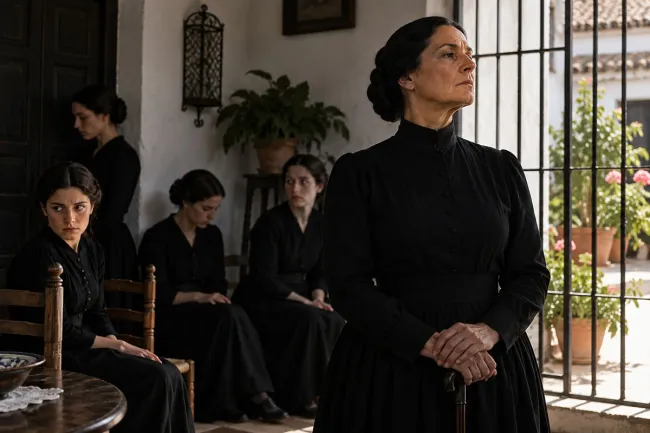
Many Spanish people remember this play as a set text from school: the walking stick, the mourning, the daughters locked away. Reread outside the classroom, it is surprising how little of it feels like homework and how much of it feels like a thriller. Everything happens in one house, over three acts, in a crescendo that never lets up.
Bernarda Alba buries her second husband and announces the plan for the years ahead: eight years of mourning, during which not a breath of air from the street will enter her house. Inside are her five daughters, aged twenty to thirty-nine, a maid who knows too much and a grandmother kept locked up because she says out loud what the others keep quiet. The balance breaks when a suitor appears for the eldest, the only one with an inheritance of her own, and the others begin to look towards the same window.
The most interesting thing is that this suitor, Pepe el Romano, never once sets foot on stage. We hear him arrive, he is talked about endlessly, there are arguments about what time he left, but he is never seen. The choice turns desire into a rumour that drifts through the house and places the whole weight of the conflict on the eight women who are there. Few plays have made so much of an absence.
Lorca subtitled it "a drama of women in the villages of Spain" and presented it as a photographic documentary, and it shows: there is hardly any verse or dazzling metaphor here, only white walls and short lines that land like blows. It is his starkest play and probably his most effective. The tension does not come from a complicated plot, but from the heat, the enforced silence and the certainty that someone is always listening behind a door.
And that is what keeps it uncomfortably alive. Bernarda's house is not a prison with bars: it is a system of surveillance in which each woman keeps watch on the others so that the village has nothing to talk about. The sisters inform on one another; the maid hoards information the way one stores ammunition; the mother rules less by her own authority than by fear of what others will see. Anyone who has watched how reputation works on a screen today will recognise the mechanism. The instrument changes, not the logic: what matters is not what is done, but what is known.
It is worth remembering when it was written. Lorca finished the play in June 1936, two months before he was murdered at the start of the Spanish Civil War. He never saw it performed; it premiered in Buenos Aires in 1945, with Margarita Xirgu. Reading it with that in mind adds a layer that is hard to ignore, although the play stands perfectly well on its own.
Not everything is equally finely tuned. The symbolism becomes explicit at times, especially with the grandmother and her lamb, and the stallion kicking at the walls underlines what the scene had already said better. Two of the sisters, Magdalena and Amelia, barely exist as characters beside Adela and Martirio, who carry the tension. These are small prices to pay in a play of barely eighty pages.
It can be read in one sitting, aloud if you like, and the ending arrives with a violence no school summary prepares you for. What lingers afterwards is not the tragedy itself, but what Bernarda does with it: the play's final gesture is to impose silence, once again.

The house of Bernarda Alba (Federico García Lorca)
One of those classics of Spanish literature that everyone should read at least once. A short, powerful and deeply human play that, through the story of a family ruled by an authoritarian mother, explores freedom, repression, social conventions and desires that no one dares to express.
Written in 1936, it remains as compelling and relevant as ever. Its language, memorable characters and steadily mounting tension make it an unforgettable read. An excellent choice for anyone wishing to discover the great classics of Spanish literature or revisit one of the masterpieces of Spanish theatre.
This post contains affiliate links. If you make a purchase through these links, we may earn a small commission at no extra cost to you. Affiliate partnerships do not influence our editorial decisions or how we choose what to publish.
About the author
Federico García Lorca (Fuente Vaqueros, Granada, 1898 – 1936) was a poet and playwright and one of the central figures of the Generation of '27. He wrote Gypsy Ballads (Romancero gitano) and Poet in New York, and, for the stage, Blood Wedding, Yerma and The House of Bernarda Alba. He was murdered near Granada in August 1936, at the start of the Civil War, and his remains have never been found. Mario Camus adapted the play for the cinema in 1987, and theatres around the world keep reviving it.
To continue the series: Pride and Prejudice, by Jane Austen, with another mother determined to marry off five daughters, though with balls instead of mourning, and Pedro Páramo, by Juan Rulfo, another village nobody seems able to leave.