
Chronicle of a Death Foretold: the murder everyone saw coming
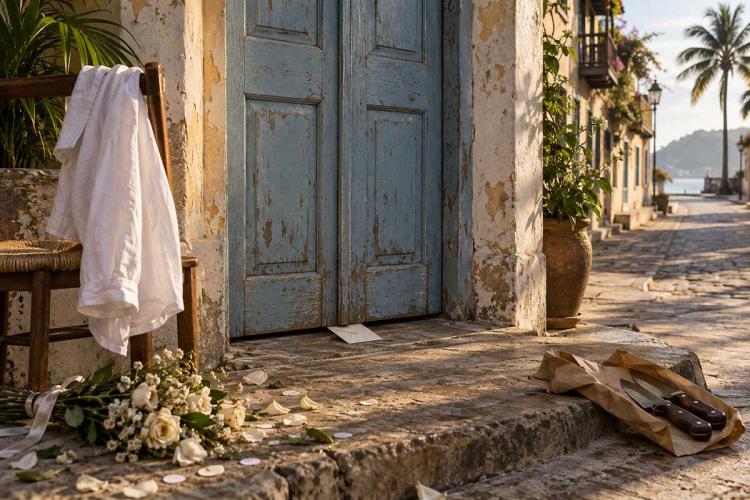
A review of Chronicle of a Death Foretold, in which García Márquez turns a murder announced in advance into a portrait of an entire town.
A novel that gives away its ending in the title, then repeats it in the first line, seems doomed never to surprise. Chronicle of a Death Foretold turns that sacrifice into its greatest strength. From the outset, it is clear that Santiago Nasar will die, who will kill him and why. What remains to be discovered is far more uncomfortable: how nobody managed to stop it.
The Vicario brothers want to avenge the honour of their sister, returned to her family on her wedding night, and they make no secret of it. They announce their plan at the market, in the shop where they wait for their victim and even to the mayor, who simply takes their knives away. The town, which knows almost to a person, divides into those who do not believe it, those who assume someone else will raise the alarm and those who quietly think the matter is just.
García Márquez was a journalist before he was a novelist, and it shows. Decades later, the narrator returns to the town and pieces together that morning from testimonies that contradict each other on what matters and agree on trivialities. Some remember a radiant day; others, gloomy weather. The device recalls Rashomon, Akira Kurosawa's film in which several witnesses describe the same crime in irreconcilable ways. Here, though, the versions do not compete for the truth. Taken together, they form a portrait of a whole community.
Read today, the novel seems to anticipate the rise of true crime, with its podcasts and documentaries that reconstruct real cases through interviews and timelines. That is no coincidence. The book grew out of a murder in Colombia in 1951, which the author turned into fiction thirty years later. The difference is that García Márquez is not looking for the culprit, who was never in doubt, but for the accomplices by omission. He finds them everywhere.
It is also his most restrained prose. Barely a trace remains of the magical realism of One Hundred Years of Solitude; what is extraordinary here is the chain of locked doors, warnings that never arrive and coincidences that conspire. Each one, on its own, is entirely plausible. Together, they have something of Greek tragedy about them, with fate replaced by inertia and a fear of what the neighbours might say.
Not everything works equally well. The sheer number of minor characters, each with a full name and an alibi of their own, can overwhelm in the opening pages. It is a small price to pay: once the map of the town comes into focus, the book runs with clockwork precision.
At barely a hundred pages, it can be read in an afternoon, but it leaves behind a question that lasts much longer: how many disasters are announced in plain sight and still run their course, because everyone assumes someone else will do something.
check price and availability of the English edition on Amazon
About the author
Gabriel García Márquez (Aracataca, Colombia, 1927 – Mexico City, 2014) began as a journalist and never entirely left the trade behind. In 1967 he published One Hundred Years of Solitude, the novel that turned magical realism into a worldwide phenomenon, and in 1982 he was awarded the Nobel Prize in Literature. Chronicle of a Death Foretold reached the cinema in 1987, directed by Francesco Rosi. One Hundred Years of Solitude premiered as a Netflix series in 2024, an adaptation the author never agreed to during his lifetime.